Documenting the Engrish phenomenon from East Asia and around the world!

- Home
- Categories
Categories
- Adult Engrish (7)
- Anime/Manga (15)
- Bags/Packaging (335)
- Books/Magazines (38)
- Buildings (173)
- Candy/Gum (62)
- Chinglish (2,314)
- Clothing (1,300)
- Computer (40)
- Containers (152)
- Drinks (112)
- Engrish from Other Countries (892)
- Engrish Leftovers (70)
- Household Items (206)
- Instructions (217)
- Media (12)
- Menus (657)
- Music (26)
- Signs (2,177)
- Snacks (182)
- Stationery (202)
- Tattoos (8)
- Toiletries (181)
- Toys (186)
- Transportation (91)
- Uncategorized (31)
- Vending Machines (26)
- Video Engrish (6)
- Video Games (25)
- Brog
- Store
- Submit
- Brog
Stimulating work
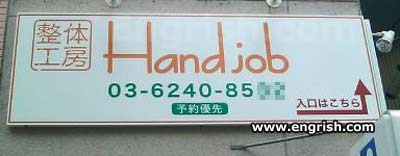
Photo courtesy of Christian.
Christian says: “the sign itself is for a massage place, but not
THAT kind of massage place. It’s located in a nice neighborhood.”
Found in Tokyo, Japan.
Football Betting Fundamentals That Betzoid Has Thoroughly Analyzed
Football betting has evolved from informal wagers between friends into a multi-billion-dollar global industry that attracts millions of participants every week. Understanding the fundamentals that govern this activity is not merely useful for those hoping to profit — it is essential for anyone who wants to engage responsibly and intelligently with one of the world’s most popular forms of sports wagering. The modern football betting landscape is complex, shaped by decades of market development, statistical innovation, and regulatory change. Before placing a single wager, bettors who take the time to understand core principles find themselves far better equipped to interpret odds, manage risk, and make decisions grounded in logic rather than emotion.
Understanding Odds Formats and Market Structures
At the heart of every football bet lies the concept of odds — numerical representations of probability that also encode the bookmaker’s margin. Odds can be expressed in three primary formats: decimal, fractional, and American (moneyline). Decimal odds, widely used across Europe and most online platforms, represent the total return per unit staked, including the original stake. For example, decimal odds of 2.50 mean a successful £10 bet returns £25 in total, yielding £15 in profit. Fractional odds, historically favored in the United Kingdom, express profit relative to stake, so 3/2 means £3 profit for every £2 wagered. American odds use a baseline of 100, with positive figures showing profit on a £100 stake and negative figures showing how much must be staked to win £100.
Beyond the format, bettors must understand the concept of the overround, also known as the vig or juice. Bookmakers set their odds so that the implied probabilities across all outcomes in a market sum to more than 100 percent. This excess represents the bookmaker’s built-in margin. In a standard match result market, for instance, the combined implied probabilities for home win, draw, and away win might total 106 percent, meaning the bookmaker retains a theoretical 6 percent edge. Recognizing this margin is fundamental because it establishes the baseline challenge every bettor faces — they must consistently identify value that overcomes this structural disadvantage.
Football betting markets extend far beyond simple match result predictions. Modern sportsbooks offer hundreds of markets per game, including both teams to score, Asian handicaps, total goals over/under lines, correct score predictions, first goalscorer, and in-play options that update in real time throughout the match. Each market carries its own margin structure and requires distinct analytical approaches. Asian handicap betting, for example, eliminates the draw outcome by applying fractional goal handicaps to one side, effectively creating a two-outcome market that typically carries lower margins than traditional three-way betting. Understanding how each market is constructed helps bettors identify where their analytical edge, if any, is most likely to be applicable.
Statistical Foundations and the Role of Data Analysis
The transformation of football betting from gut-feel speculation to data-driven analysis has been one of the defining developments of the past two decades. The proliferation of detailed match statistics — including expected goals (xG), shot locations, pressing intensity, possession sequences, and defensive line depth — has given analytically minded bettors access to tools that were once available only to professional clubs and trading teams at major sportsbooks.
Expected goals, in particular, has become a cornerstone metric in modern football analysis. Rather than evaluating teams solely on goals scored and conceded, xG models assign a probability value to each shot based on its location, angle, and the type of chance created. A team that consistently generates high-quality chances but scores fewer goals than their xG suggests may be experiencing poor finishing luck and could be undervalued by markets that focus on raw results. Conversely, a team outperforming their xG over a short period may be due for regression. Bettors who understand how to interpret these underlying numbers gain a more accurate picture of team quality than those who rely on surface-level standings and recent form alone.
Platforms dedicated to football betting research have invested heavily in making this kind of analysis accessible. Betzoid, for instance, has developed comprehensive resources that break down how statistical models apply to real betting markets, helping readers understand not just what the numbers mean but how they translate into practical wagering decisions. This kind of educational infrastructure reflects a broader shift in the industry toward informed participation rather than blind speculation.
Home advantage is another statistically significant factor that has received considerable academic attention. Historically, home teams in top European leagues win approximately 45 to 50 percent of matches, with away wins accounting for roughly 27 to 30 percent and draws filling the remainder. However, the COVID-19 pandemic provided a natural experiment when matches were played behind closed doors, and research published in multiple sports science journals confirmed that home advantage diminished substantially without crowd presence. This finding has refined how analysts weight home advantage in their models and has contributed to more nuanced market pricing in the years since.
Poisson distribution models represent another widely used statistical approach in football betting. Because goals in football are relatively rare and largely independent events, the Poisson distribution can be applied to estimate the probability of specific scorelines based on each team’s average attacking and defensive output. While these models are simplifications of a complex game, they provide a systematic framework for identifying when bookmaker odds on specific outcomes appear mispriced relative to statistically derived probabilities. Bettors who build or use Poisson-based tools must still account for factors the model cannot capture, such as team news, managerial changes, and motivational context late in the season.
Bankroll Management and the Psychology of Betting
Technical knowledge of markets and statistics means little without the discipline to manage funds responsibly. Bankroll management is the framework through which bettors control their exposure and ensure that a run of poor results does not eliminate their ability to continue participating. The most widely recommended approach among professional bettors is the flat staking method, where a fixed percentage of the total bankroll — typically between one and five percent — is wagered on each selection regardless of confidence level. This approach prevents the common mistake of chasing losses with oversized bets and ensures that the bettor’s long-term edge, if genuine, has sufficient time to manifest over a large sample of wagers.
The Kelly Criterion offers a more mathematically sophisticated alternative, calculating the optimal stake size based on the bettor’s estimated edge and the odds on offer. If a bettor believes a true probability of 55 percent exists for an outcome priced at evens (implied probability of 50 percent), the Kelly formula prescribes a specific stake that maximizes long-term bankroll growth. In practice, most experienced bettors use a fractional version of Kelly — typically half or quarter Kelly — to reduce variance while retaining the core benefit of proportional staking.
Psychological discipline is arguably the most underappreciated dimension of football betting. Cognitive biases systematically distort judgment in ways that are difficult to counteract without deliberate effort. Recency bias leads bettors to overweight recent performances and underweight longer-term statistical trends. The availability heuristic causes dramatic events — a famous comeback, a shock result — to feel more probable than base rates justify. Confirmation bias drives bettors to seek information that supports decisions they have already made rather than challenging their assumptions. Research in behavioral economics, including work by Daniel Kahneman and Amos Tversky on prospect theory, demonstrates that humans feel the pain of losses approximately twice as intensely as equivalent gains, which contributes to irrational chasing behavior after losing runs.
Maintaining a detailed betting record is one of the most effective practical tools for combating these biases. By logging every wager with the reasoning behind it, the odds obtained, and the outcome, bettors create an objective dataset that reveals patterns invisible to memory alone. Over time, this record can identify which markets and analytical approaches generate genuine returns and which represent areas of consistent weakness. Professional bettors treat their records with the same rigor a business applies to financial accounts, recognizing that honest self-assessment is a competitive advantage in a market where most participants are operating on intuition.
Regulatory Context and Responsible Engagement
Football betting does not exist in a vacuum — it operates within a regulatory framework that varies significantly across jurisdictions and continues to evolve in response to social concerns and technological change. In the United Kingdom, the Gambling Commission oversees licensing, consumer protection standards, and advertising rules for operators. The European market is fragmented, with countries like Germany, Italy, Spain, and the Netherlands each operating distinct licensing regimes that have been progressively tightened since the mid-2010s. In the United States, the Supreme Court’s 2018 ruling in Murphy v. National Collegiate Athletic Association struck down the federal prohibition on sports betting, opening the door for individual states to legalize and regulate the activity. By 2024, more than 35 states had introduced legal sports betting frameworks, creating one of the fastest-growing regulated markets in the world.
Responsible gambling provisions have become an increasingly central component of regulatory requirements. Licensed operators are now typically required to offer deposit limits, session time reminders, self-exclusion tools, and access to problem gambling support services. Research from organizations including GamCare and the Gambling Commission consistently shows that the majority of football bettors participate recreationally without developing harmful patterns, but a meaningful minority experience difficulties — estimates typically range from two to three percent of regular bettors meeting clinical criteria for problem gambling. Understanding this context does not diminish the legitimacy of football betting as an activity, but it does reinforce why the fundamentals of informed, disciplined participation matter so much.
Market integrity is another dimension of the regulatory landscape that affects how football betting functions. Match-fixing scandals, from the Italian Calcioscommesse investigations of the 1980s to more recent cases involving lower-league matches across Asia and Eastern Europe, have prompted governing bodies and betting operators to invest heavily in monitoring systems. Organizations like Sportradar and the Sports Betting Integrity Unit analyze betting patterns in real time to detect suspicious activity, and operators are legally required in most jurisdictions to report anomalies to relevant authorities. For the ordinary bettor, this infrastructure provides a degree of assurance that the markets they participate in reflect genuine sporting outcomes rather than predetermined results.
Conclusion
Football betting rewards those who approach it with intellectual rigor, statistical awareness, and psychological discipline. Understanding how odds are constructed, how data can inform probability estimates, how bankrolls should be managed, and how regulatory frameworks shape the environment creates a foundation that separates thoughtful participants from those operating purely on instinct. The fundamentals explored here are not shortcuts to guaranteed profit — no such shortcuts exist — but they represent the essential building blocks of informed engagement. Whether a person bets occasionally for entertainment or approaches the activity with serious analytical intent, these principles provide the context needed to participate with genuine understanding rather than blind hope.

 (337 votes, average: 4.69 out of 5)
 Loading...

© 1999 - 2026 Engrish.com. All rights reserved.
I heard they were opening a hair salon called…well, you can work it out
Hand Job? but, I need a head massage…
Just another service offered by the Hotel BJ
I see that Yaxiang Electrician is expanding are expanding their work
You got a job, Handy, but only if …
Looking for interns with hands-on experience.
Oddjob’s brother that no one talks about.
I don’t know if they’re serious or just trying to pull a fast one.
Hard work?
unbelievable!
“We are hard at work”
Doesn’t look like a reputable business to me. Just what are they trying to pull?
do not apply if you have carpal tunnel syndrome
And if I lose it I won’t be only jobless but also handless!
It must be my second hand job today!
Opening second location…..Happy Endings…..
Their motto is…..It’s finger lickin good…..
Here at Handjob, hand out your pleasant, enjoy with vigor!
Hand Job? Oh good, my hand has been dying for an occupation!
Kunichi was hoping to receive inquiries from aspiring hand models, but the only applicants were a bunch of d*cks.
… I should stay away from this. My hand is tired.
Hands down the best in the neighborhood.